
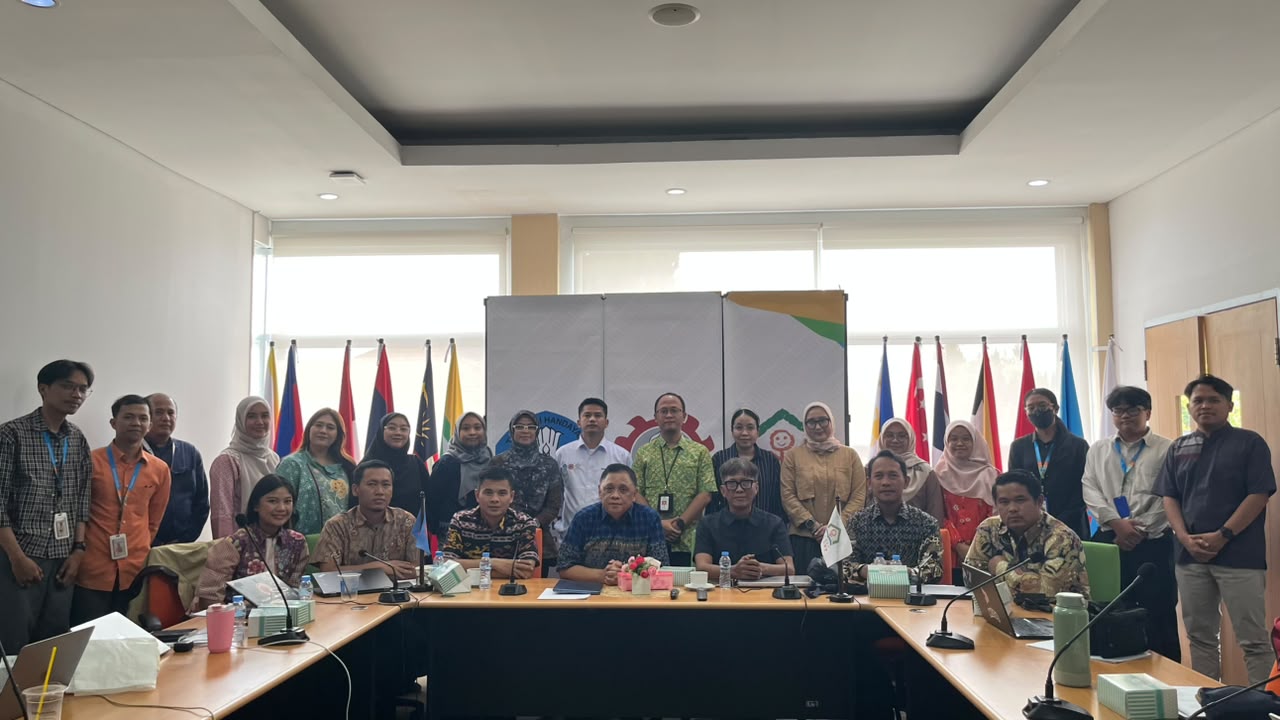
Lembang, 29 October 2026 – SEAMEO CECCEP and the Ministry of Social Affairs held an Enumerator Briefing as part of the preparations for a study entitled “A Study of Out-of-School Children in Remote Indigenous Communities from the Perspective of Child Care.” The activity, which took place in the Conference Room, involved representatives of SEAMEO CECCEP, the Directorate of Child Social Rehabilitation of the Ministry of Social Affairs, the Banten Provincial Education Quality Assurance Center (BPMP), the Lebak District Education Office, and other research partners.
The briefing aimed to strengthen the enumerators’ understanding and readiness to carry out data collection in the Baduy indigenous community. The aspects that received attention included an understanding of qualitative research methodology, in-depth interview techniques, observation, field notes, and the application of research ethics principles involving children.
In the opening session, Heri Kosmawan of SEAMEO CECCEP emphasized the importance of understanding the research instruments, as well as the enumerators’ ability to adapt their approach to the conditions of the local community. The interview guide that had been developed did not have to be applied rigidly or in sequence. Enumerators needed to build natural communication, give informants room to tell their experiences, and avoid repeating questions once the required information had been obtained.
The material on qualitative research methodology was delivered by Dwi Yuliani. She explained that qualitative research positioned the researcher as the main instrument, responsible for observing, listening, exploring information, and understanding informants’ experiences within the context of their everyday lives. Therefore, enumerators needed to build good relationships (trust building) with the community before collecting data.
Dwi also emphasized the importance of maintaining an open attitude and not bringing personal assumptions into the field. Enumerators were expected to understand the values, child-rearing practices, and customs of the Baduy people without making judgments based on perspectives from outside the community. Data were collected through in-depth interviews, observation, and a review of documentation, where available and permitted by the community.
In addition, field notes were one of the important aspects that required attention. Every piece of information obtained had to be documented immediately using informant codes to protect the confidentiality of identities. The notes also needed to include observed facts, the researcher’s reflections, unconfirmed information, and the need for further exploration. To ensure data quality, enumerators were directed to apply source and technique triangulation, confirm information, and pay attention to differing or contradictory findings as part of the analysis process.
Another important aspect of the briefing was the application of research ethics involving children. Drs. Widodo, M.Si. of SEAMEO CECCEP stated that research involving children had to balance two fundamental rights: the child’s right to protection and the child’s right to be heard. Children were a vulnerable group, so every stage of the research needed to consider the child’s safety, comfort, privacy, and freedom to give consent or refusal.
In the context of research in the Baduy indigenous community, ethics were applied through a triple-layered consent mechanism, which included permission from customary leaders and local institutions, consent from parents or guardians, and the child’s willingness to participate (informed assent). Enumerators also needed to use simple language that children could easily understand, respect a child’s decision not to participate, and pay attention to nonverbal signs of refusal such as remaining silent, moving away, or crying.
The do no harm principle also served as a main foundation for conducting the research. Children’s welfare and protection always had to be placed above the interest of obtaining data. In addition, enumerators needed to respect customary values and rules, including provisions on visual documentation, norms of dress and communication, and the Baduy community’s child-rearing routines. Observations were conducted passively and did not interfere with the natural activities of families or children.
In the next session, Prof. Eri provided reinforcement regarding approaches and strategies for data collection in the field. He reminded participants that enumerators needed to understand the characteristics of Baduy life, which had routines and customs different from those of society in general. Therefore, the research instruments needed to be used flexibly, prioritizing a humanistic approach, comfortable communication, and respect for informants’ daily activities.
Prof. Eri also emphasized that building community trust was an important part of the research’s success. Enumerators were not to be overly fixated on the list of questions or force the interview process if informants showed discomfort. Questions needed to be delivered in contextual and simple language so that the community’s experiences and views could be explored more naturally.
The activity also served as a space for participants to discuss various technical challenges they might face during data collection. The topics discussed included language limitations, strategies for building closeness with the community, the division of teams and research areas, the need for local companions, and the adjustment of documentation methods to customary rules. Inter-institutional coordination and the mapping of team members’ abilities, particularly in the Sundanese language, were part of the preparations that needed to be followed up before departure to the research location.
Through this briefing, SEAMEO CECCEP and its partners were expected to ensure the enumerators’ readiness to produce research data that was high-quality, contextual, and accountable. Beyond meeting data collection needs, the study was expected to provide a deeper understanding of child-rearing practices, the fulfillment of children’s rights, and the dynamics of education for out-of-school children within the context of indigenous community life.
The results of the study were subsequently intended to produce a policy brief as input for developing policies that were more responsive to the needs and rights of children, particularly children living in remote indigenous communities.
Share This News