
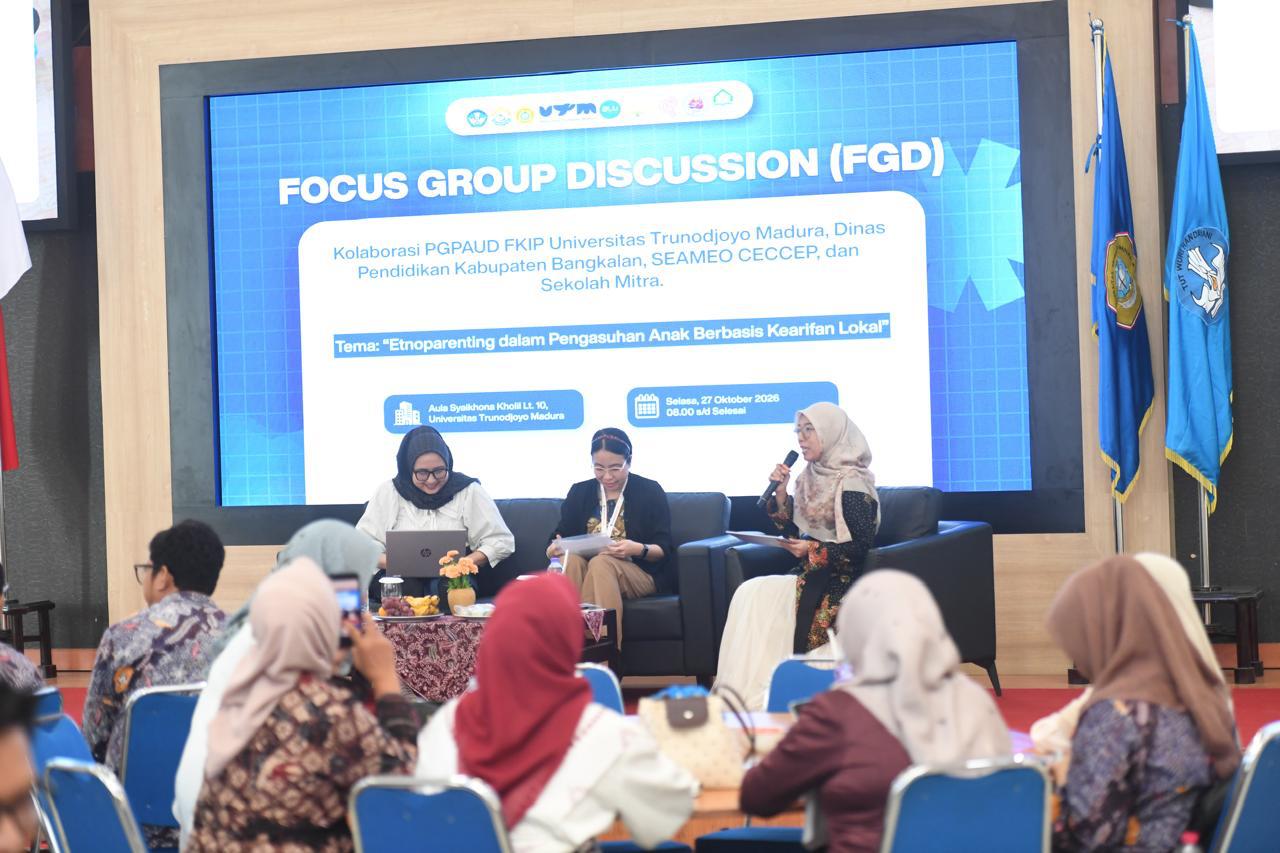
Bangkalan, 27 October 2026 – Strengthening locally rooted early childhood parenting practices was one of the efforts to build partnerships among families, Early Childhood Education (ECE) institutions, and communities. This issue was addressed in a Focus Group Discussion (FGD) themed “Ethnoparenting in Locally Rooted Child Care,” which involved SEAMEO Regional Centre for Early Childhood Care Education and Parenting (SEAMEO CECCEP), the Early Childhood Teacher Education Study Program (PGPAUD), the Faculty of Teacher Training and Education (FKIP), Universitas Trunojoyo Madura, the Bangkalan Regency Education Office, and partner schools.
The discussion provided a space to examine the potential of Madurese local wisdom in supporting positive parenting that was relevant to children’s developmental needs, The findings were presented in a policy brief titled “Strengthening Parenting and Parental Involvement in Early Childhood Education,” which contained recommendations for strengthening programs and family engagement in ECE institutions.
For SEAMEO CECCEP, strengthening parenting was an essensial part of supporting children’s holistic development. Children’s development was influenced not only by learning experiences in ECE institutions, but also by daily interactions at home, relationships with family members, and the social and cultural environments in which children grew.
In the context of Madurese society, the philosophy of Bhuppa’ Bhabhu’ Ghuru Rato, which referred to father, mother, teacher and leader, could serve as one entry point for understanding the relationships among families, educators, and communities. Values such as family responsibility, respect, togetherness, and social solidarity had the potential to become sources for developing parenting practices and family partnerships with ECE institutions.
However, local wisdom needed to be examined critically so that its application remained aligned with the principles of positive parenting, child protection, and the best interests of the child. Family dynamics, social change, and the use of digital technology also required parenting approaches that were adaptive to the needs of contemporary children and families.
Strengthening Parenting as Part of ECE Services
One of the main issues highlighted in the policy brief was the need for parenting programs that were well-planned, sustainable, and responsive to families’ needs. Parenting was not supposed to be limited to incidental parent meetings, it needed to become part of efforts to improve the quality of ECE services.
Family involvement also needed to be understood more broadly. In addition to mothers, fathers, grandparents, and other family members could play a role in supporting children’s growth and development. Therefore, ECE institutions needed to provide flexible and accessible spaces for participation, taking into account time constraints, caregiving responsibilities, and the diverse social and educational circumstances of families.
This approach positioned parents as partners in children’s education, rather than merely recipients of information from schools, Two-way communication between educators and families was essensial so that support for children’s development could be sustained consistently both at home and in ECE institutions.
Four Policy Priorities for Strengthening Ethnoparenting
The policy brief discussed during the FGD proposed four policy brief priorities to strengthen locally rooted parenting programs in Bangkalan Regency.
Strengthening parenting programs in ECE institutions
Parenting programs needed to be supported by clear guideline, regular activity calendars integrated into institutional planning, and research-based ethnoparenting modules. The materials could cover non-violent discipline, guidance on children’s use of digital devices, respectful communication, and intergenerational parenting. Capacity building for teachers and education personnel was also needed to ensure effective program implementation.
Increasing parental involvement
ECE institutions needed to develop accessible and flexible parenting activities including two-way communication through communication books or digital media. Involving fathers, grandparents, and parent groups in activity planning was one way to expand family support for children’s education.
Strengthening institutional collaboration
Collaboration among local governments, ECE institutions, higher education institutions, and relevant partners needed to be supported by clear role division, coordination mechanisms, and funding. This cooperation could also open access to academic support and referrals to psychologists or specialists according to the needs of children and families.
Moniroting, evaluation, and sustainability
The implementation of parenting programs should have been accompanied by simple monitoring instruments, regular reflection sessions involving schools and parents, and reporting at the regency level. Documenting good practices and disseminating lessons learned could support the development and replication of programs in other ECE institutions.
These four priorities emphasized the strengthening ethnoparenting required policy support, educator capacity, family participation, and cross-sector collaboration. Local wisdom could serve as a foundation for program development, while research and evaluation helped ensure that the practices implemented remained relevant to the needs of children and families.
Connecting Research, Policy, and Parenting Practice
The collaboration among SEAMEO CECCEP, Universitas Trunojoyo Madura, the Bangkalan Regency Education Office, and partner schools created space to connect academic research with the practical needs of parenting and early childhood education. Through dialogue among stakeholders, the recommendations in the policy brief were expected to inform the development of more contextual and sustainable parenting programs.
Strengthening ethnoparenting was not solely about preserving traditions, it was also about identifying and developing cultural values that supported positive caregiving relationships, respect for children’s rights, and family involvement in education. Through an approach that connected local wisdom, research evidence, and policy support, strengthening parenting was expected to reinforce the continuity between home, ECE institutions, and communities. In this way, families and educators could share responsibility for creating safe, supportive environments that promoted every child’s growth and development.
Share This News