
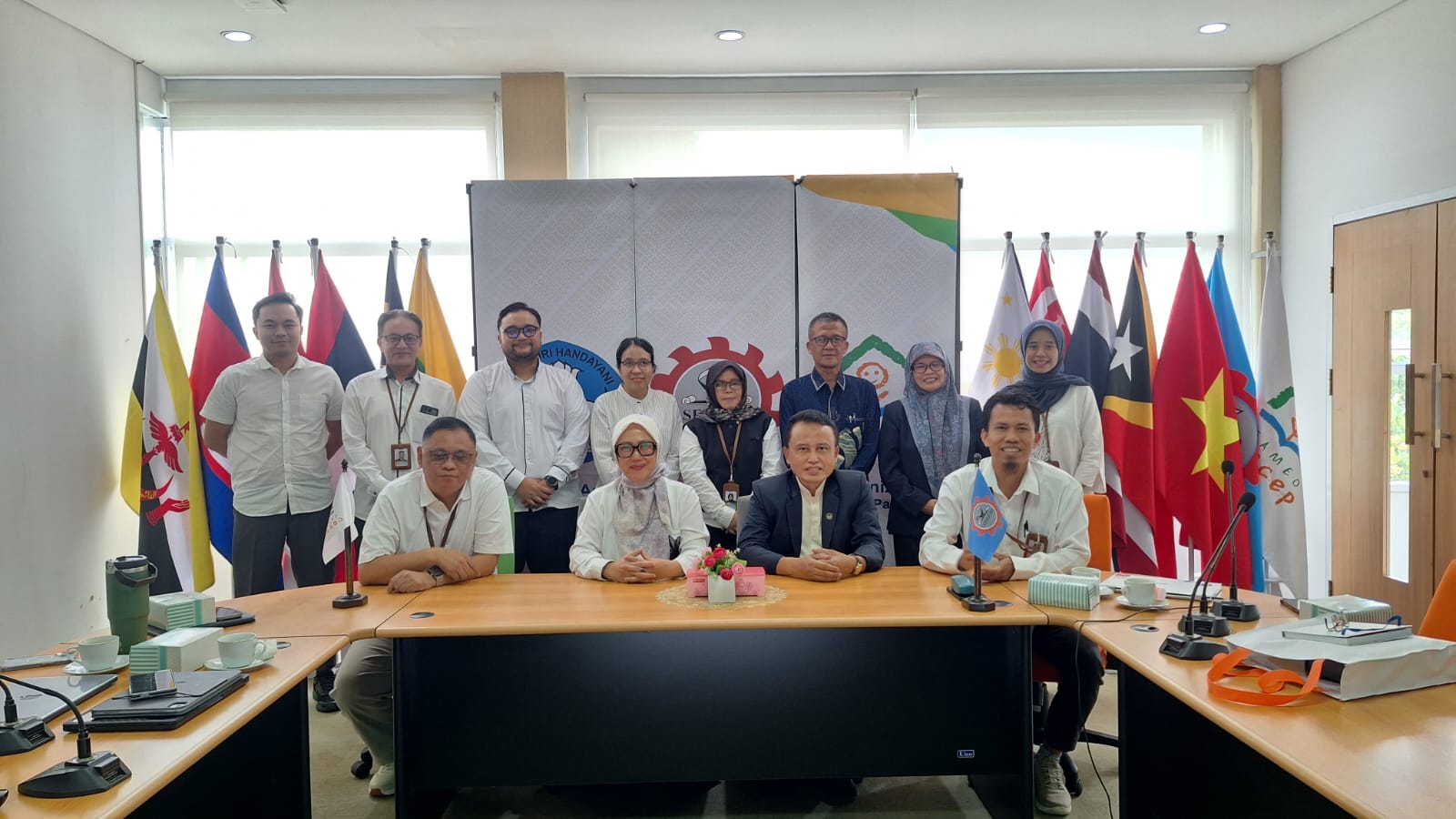
Bandung, 26 August 2026- The SEAMEO Regional Centre for Early Childhood Care Education and Parenting (SEAMEO CECCEP) had welcomed an audience visit from the Ikatan Guru Aisyiyah Bustanul Athfal (IGABA) to discuss potential collaboration in human resource development, particularly in strengthening the capacity of Kindergarten Aisyiyah teachers across Indonesia. The meeting had provided a platform for both institutions to discuss various forms of collaboration, including teacher training programmes, seminars, and joint research opportunities in the field of early childhood care and education (ECCE).
Representatives from IGABA had highlighted the importance of ensuring that TK Aisyiyah teachers
could access continuous professional development opportunities. IGABA had expressed its hope that the collaboration with SEAMEO CECCEP would reach not only teachers in urban areas but also educators in various regions, ensuring equal opportunities for capacity building.
The Director of SEAMEO CECCEP had explained that the Centre had previously conducted several teacher capacity-building programmes, including training programmes in collaboration with Yayasan Ardhya Garini (Yasarini), which had been conducted online for one year, as well as face-to-face training programmes with Universitas Ahmad Dahlan (UAD). Moving forward, IGABA would also be invited to participate in SEAMEO CECCEP activities, including training programmes and knowledge-sharing events.
“If SEAMEO CECCEP organised events, IGABA could be involved as a partner. Likewise, SEAMEO CECCEP would be open to collaborating in IGABA activities,” the Director of SEAMEO CECCEP stated during the discussion.
Deputy Director for Administration of SEAMEO CECCEP, Suhendri, Ph.D., had added that collaboration with IGABA had significant potential, particularly in supporting programme implementation at the community level, such as providing participants, research respondents, resource persons, and utilising learning modules developed by SEAMEO CECCEP. He explained that collaboration would not only focus on financial support
but could also be implemented through an in-kind collaboration scheme, similar to previous training programmes. Furthermore, strengthening the partnership through a Memorandum of Agreement (MoA) had been considered important to establish a clearer framework for future cooperation.
During the meeting, SEAMEO CECCEP had also informed IGABA about the Centre’s efficiency measures, which had affected programme implementation. Therefore, collaborative approaches, including possible cost-sharing mechanisms for training programmes, seminars, and international conferences, would be considered in future activities.
The Head of Partnership and Advocacy Division of SEAMEO CECCEP had explained that the Centre would facilitate further discussions regarding potential collaboration. Currently, SEAMEO CECCEP had also been conducting support programmes with local governments, including the Subang Regency Government, in strengthening Holistic Integrative Early Childhood Education (PAUD HI) policies.
SEAMEO CECCEP had also presented its existing teacher training programmes. Responding to IGABA’s inquiry regarding flexible training formats, SEAMEO CECCEP had explained that training packages could be modified and adjusted based on partners’ needs, either as intensive programmes or shorter learning sessions. In addition to training programmes, the Director of SEAMEO CECCEP had encouraged collaboration through international seminars and knowledge-sharing activities. One example discussed was a seminar combined with creative learning approaches for ECCE teachers, incorporating arts, music, and innovative learning experiences.
Bagikan Artikel