
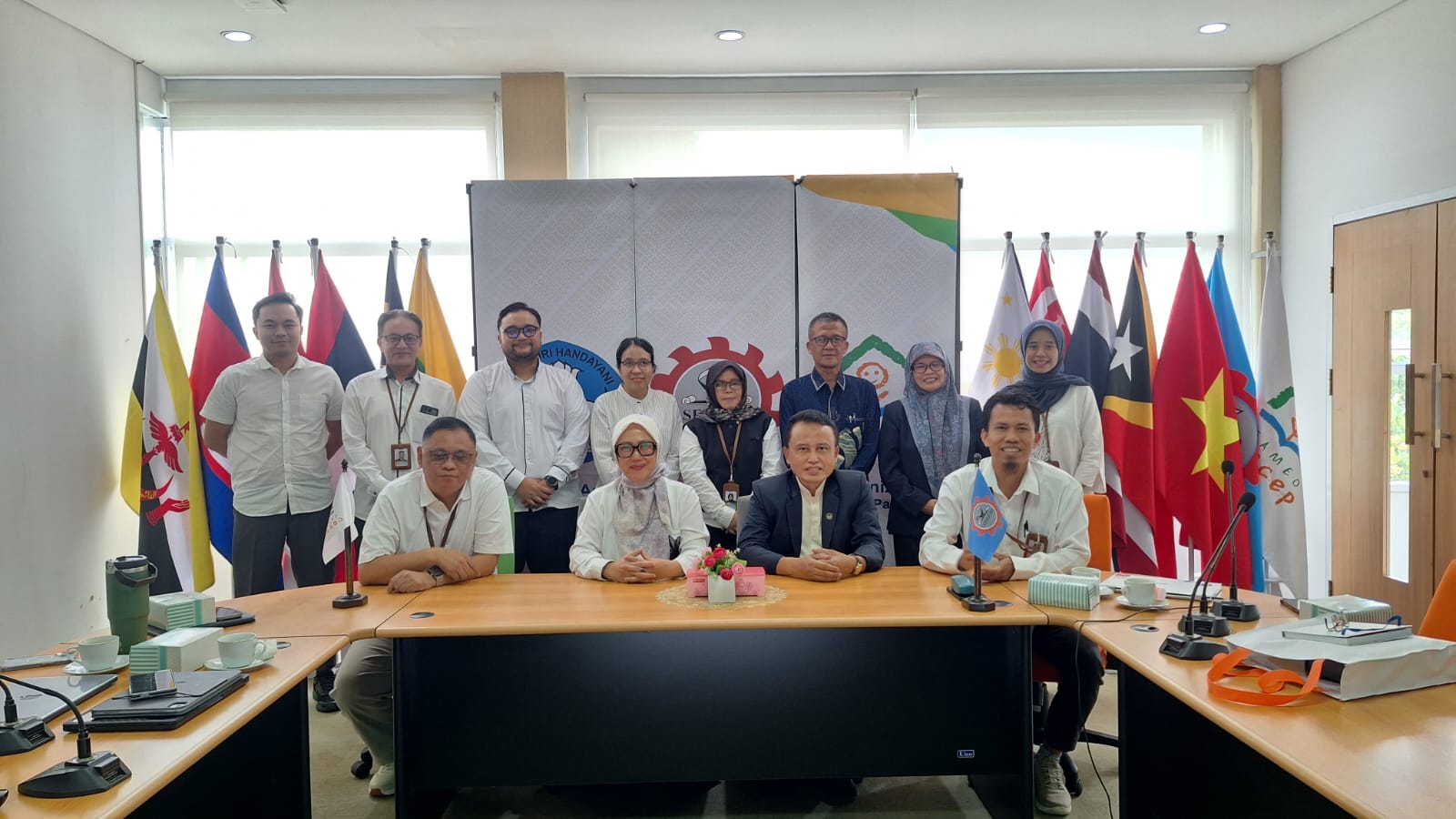
Jakarta, 11 August 2026 – The SEAMEO Regional Centre for Early Childhood Care Education and Parenting (SEAMEO CECCEP), in collaboration with Universitas Islam Internasional Indonesia (UIII) and Universitas Muhammadiyah Prof. Dr. Hamka (UHAMKA), strengthened research collaboration to map early childhood teachers’ competencies in numeracy instruction through the Coaching Pilot Study of Instrument Development for Mapping Kindergarten Teachers' Mathematics Knowledge for Teaching.
The activity was part of the instrument development and pilot testing process, which was designed to provide an overview of kindergarten teachers’ competencies in teaching mathematical and numeracy concepts to young children. The activity involved research teams from UIII, UHAMKA, and SEAMEO CECCEP, expert validators, academics, and early childhood teachers who participated in the pilot study.
Deputy Director for Programme of SEAMEO CECCEP, Widodo Suhartoyo, expressed his appreciation to UHAMKA for hosting the activity, as well as to UIII and all parties involved in the development of the research. He stated that collaboration among regional institutions, higher education institutions, academics, and education practitioners was important in producing research that was relevant to the needs of early childhood education.
“We believed that the synergy between SEAMEO CECCEP, UIII, and UHAMKA represented a strong collaboration among a regional institution, higher education institutions, and education practitioners in producing quality research and making a meaningful contribution to improving the quality of early childhood education,” said Widodo.
Strengthening numeracy from an early age was an important aspect of building a strong foundation for children’s learning. Numeracy was not limited to counting skills but also included the ability to recognize patterns, understand quantitative relationships, think logically, and solve problems.
In this context, teachers’ competencies played an important role in creating mathematics learning experiences that were appropriate to children’s characteristics and developmental stages. The research focused on developing an instrument on Mathematics Knowledge for Teaching (MKT) that could be used to map early childhood teachers’ competencies in teaching numeracy in Indonesia.
The research had three main objectives: to map early childhood teachers’ competencies in teaching numeracy, identify gaps in teaching competencies among early childhood teachers, and analyze teachers’ understanding of numeracy concepts for young children.
Before being used in a broader-scale study, the instrument had to undergo a pilot study to ensure its quality and suitability for the Indonesian educational context.
“Through the development of a validated instrument, we could obtain a more accurate picture of kindergarten teachers’ competencies in teaching basic mathematical concepts. The findings from this pilot study could subsequently serve as a basis for formulating policies, teacher training programmes, and more targeted teacher capacity-building interventions,” explained Widodo.
For SEAMEO CECCEP, the development of the instrument was part of its commitment to strengthening evidence-based research in early childhood education and parenting. Data on teachers’ competencies and gaps in numeracy instruction were expected to provide stronger information for the development of teacher education programmes and continuing professional development.
Through a more systematic mapping process, teachers’ capacity-building needs could be identified more accurately, allowing training programmes to be tailored to teachers’ competency needs rather than being limited to general training approaches. Beyond its academic contribution, the research was also expected to provide information for the development of teacher education and professional development programmes for early childhood teachers in the future.
The Coaching Pilot Study also served as an important opportunity to strengthen collaboration among SEAMEO CECCEP, UIII, and UHAMKA in the field of early childhood education research. Co-Lead Researcher from UIII, Destina Wahyu Winarti, Ph.D., together with the numeracy research teams from UIII, UHAMKA, and SEAMEO CECCEP, contributed to the development of the research and instrument.
The involvement of expert validators and early childhood teachers in the pilot study was an important part of ensuring that the instrument had good quality while remaining relevant to learning conditions and practices in the field.
SEAMEO CECCEP hoped that the collaboration would continue to develop through joint research, capacity building, knowledge exchange, and the development of evidence-based policy recommendations. More broadly, the research was expected not only to contribute to strengthening numeracy learning in Indonesia but also to serve as a reference for further studies on early childhood teachers’ competencies in Southeast Asia.
Through collaboration among regional institutions, higher education institutions, researchers, and education practitioners, SEAMEO CECCEP continued to promote research that was academically rigorous while remaining relevant to the needs of teachers and young children in the field.
Share This News