
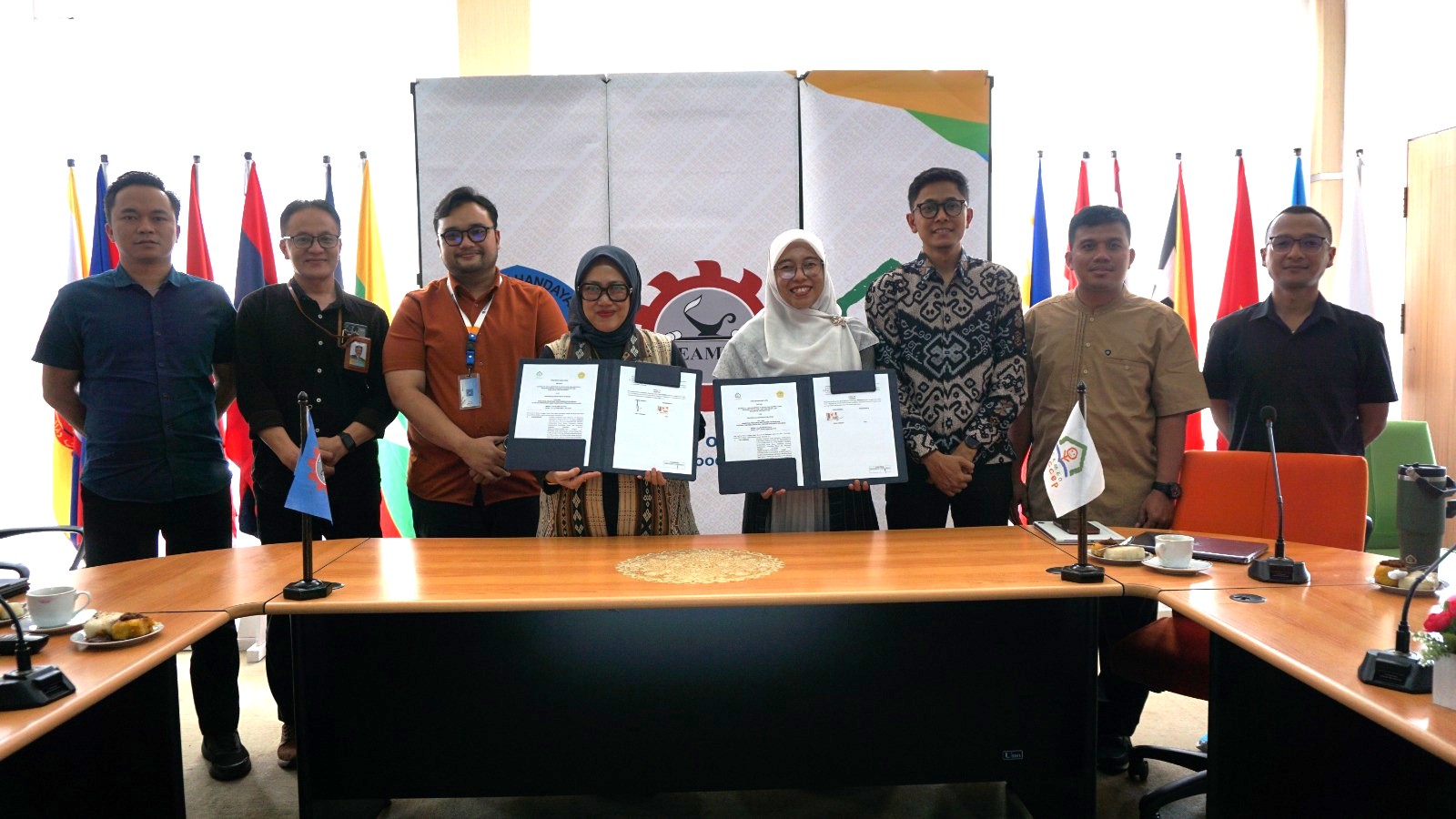
Bandung, 17 November 2026 – SEAMEO CECCEP and
Trunojoyo University of Madura (UTM) strengthened their synergy in developing
early childhood education and parenting through a discussion and the signing of
a Cooperation Agreement (PKS). The event took place on Tuesday (17/11) in the SEAMEO
CECCEP Conference Room. The meeting was a first step toward developing
collaboration in research, human resource capacity building, and the
strengthening of parenting practices oriented to the needs and characteristics
of local communities.
The
event began with remaks by Siti Fadjryana Fitroh, S.Psi., M.A., representing
UTM, and Prof. Vina Adriany, M.Ed., Ph.D., Director of SEAMEO CECCEP. The
discussion, moderated by Rizal Nugraha, S.Si., M.Pd., covered several
opportunities for cooperation, including the dissemination of ethnoparenting
research findings, the development of a climate change module, and mentoring
for Holistic-Integrative Early Childhood Education (PAUDHI).
In
the ethnoparenting discussion, both institutions highlighted the importance of
understanding parenting practices based on cultural values and local wisdom.
UTM expressed interest in developing research on parenting patterns among the
Madurese people, particularly in eastern Madura. The research findings were
expected to serve as the basis for a policy brief to inform the development of
child education and parenting policies.
In
addition, developing educators’ capacity through the climate change module was
one of the discussion focal points. SEAMEO CECCEP stated that the module was
entering its piloting stage to identify and correct misconceptions about
climate change. The module was intended for early childhood education (PAUD)
teachers so that they could integrate knowledge about climate change into their
teaching and learning. Opportunities for collaboration were also open through
other programs, such as P2KS, PPSP, Happy Neighbourhood, GEMBIRA, and deep
learning.
On
the same occasion, UTM outlined several challenges in early childhood education
and parenting in Madura, ranging from limited access to education and a lack of
play facilities in PAUD units to the need to improve parents’ understanding of
parenting practices. The involvement of extended family, especially
grandparents, was also a characteristic of local parenting that needed
attention. In addition, strengthening communication between PAUD institutions
and parents through ongoing parenting activities was considered important for
supporting children growth and development.
Responding
to these opportunities, Prof. Vina Adriany emphasized the importance of
cross-institutional and partner collaboration in delivering programs that
suited community needs. One opportunity discussed was developing a joint
proposal with Rocket Learning on parenting and cadre capacity building.
Collaboration with local governments, including the Bunda-Bunda Desa (Village
Mothers), also had the potential to expand program implementation while
strengthening policy support and funding for early childhood education.
Through
this cooperation, SEAMEO CECCEP and UTM hoped to build contextual and
sustainable collaboration. The synergy in research, capacity building, and the
use of local cultural potential was expected to contribute to improving the
quality of early childhood education and parenting services, as well as the
well-being of young children.
Bagikan Artikel