
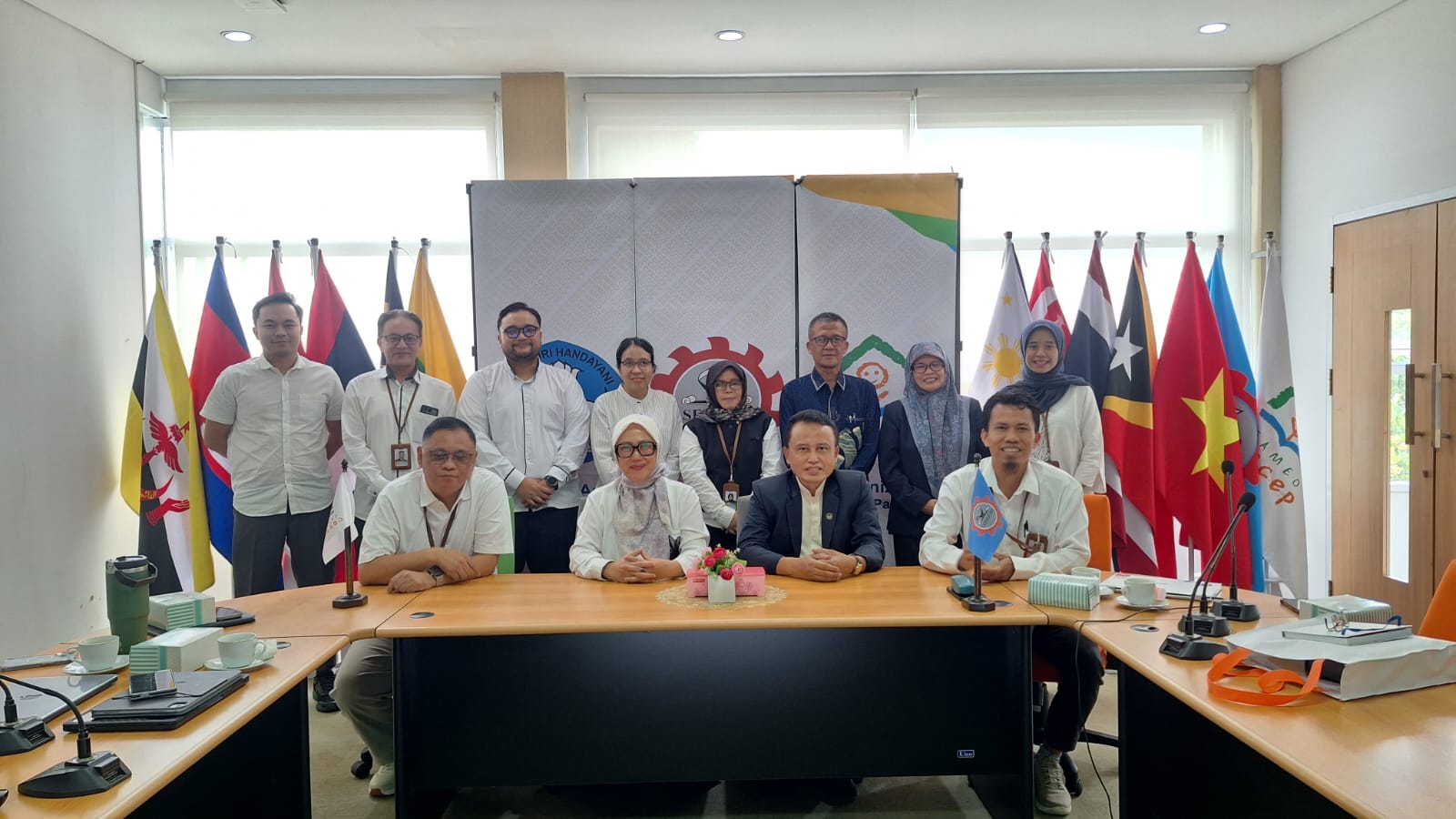
Lembang, 13 October 2026 — The SEAMEO Regional Centre for Early Childhood Care Education and Parenting (SEAMEO CECCEP) and the Indonesian Child Protection Institute (Lembaga Perlindungan Anak Indonesia/LPAI) explored opportunities for collaboration to strengthen child protection through responsive parenting, inclusive education, and the creation of safe and child-friendly environments.
The meeting provided an opportunity for both institutions to exchange perspectives on challenges related to the fulfilment of children’s rights, the improvement of Early Childhood Education (ECE) services, and the importance of collaboration among families, educational institutions, and communities in supporting children’s growth and development.
During the meeting, SEAMEO CECCEP Director Prof. Vina Adriany, Ph.D., emphasised the importance of fulfilling children’s rights from an early age. In addition to expanding access to ECE services, improving service quality and strengthening educators’ capacities were identified as important priorities. These efforts also required children’s perspectives and participation to be mainstreamed into programmes and policies affecting their lives.
Meanwhile, LPAI Chairperson Samsul Ridwan, accompanied by Secretary-General Fadiah Machmud, Deputy Secretary-General M. Zainuddin, and Supervisory Board Member Tri Slamet R., presented LPAI’s programme priorities for strengthening children’s rights and protection. These efforts included preventing violence against children, advocating for children’s rights, strengthening community involvement, and developing more integrated child protection services.
LPAI also highlighted the importance of prioritising children in vulnerable situations, including those from vulnerable families and those with limited access to parenting support and protection services. Community involvement and cross-sectoral collaboration were considered essential to expanding service coverage and responding more comprehensively to children’s needs.
One of the collaboration opportunities discussed was the RAISE programme (Responsive Parenting, Inclusive Education and Safe Environments for Children), which LPAI proposed as a model to strengthen responsive parenting, inclusive education, and safe environments for children.
The programme emphasised the importance of continuity between parenting practices at home and children’s learning experiences in ECE settings. Communication and collaboration among parents, educators, and communities were considered essential to ensuring that children experienced environments that respected their rights, needs, and participation.
The proposed 12-month programme included activities such as education on children’s rights and protection, training on child protection in digital spaces, community-based mentoring and monitoring, public awareness campaigns, and regular forums for teachers and parents.
The initial plan proposed piloting the programme in three provinces, with five ECE centres in each province, covering a total of 15 centres. The pilot locations and implementation arrangements remained subject to further discussion, including opportunities to engage ECE organisations such as HIMPAUDI and IGTKI.
Through this approach, RAISE was expected to improve parents’ understanding of positive parenting, strengthen educators’ capacities to create inclusive learning environments, and increase community involvement in child protection.
During the meeting, SEAMEO CECCEP also introduced several programmes and learning resources relevant to strengthening ECE services, including the OHN and GEMBIRA modules and the anti-bias education approach. Anti-bias education promotes learning environments that respect diversity, prevent discrimination, and provide every child with equitable opportunities to participate.
These resources and approaches could serve as references for further discussions on aligning SEAMEO CECCEP’s expertise with the RAISE programme, particularly in educator capacity development, parenting practices, and the creation of safe and inclusive learning environments.
The discussion also highlighted the need to strengthen connections among families, schools, and communities. Child protection was understood not only as responding to cases of rights violations but also as preventing harm through responsive parenting, supportive learning environments, and communities that understood their role in protecting children.
As follow-up actions, both institutions identified the need to further explore the alignment between RAISE and SEAMEO CECCEP’s programmes and learning resources. Further discussions were also needed to identify pilot locations, define roles and responsibilities, establish success indicators, and develop programme monitoring and evaluation mechanisms.
Through this initial engagement, SEAMEO CECCEP and LPAI explored opportunities to build synergies in strengthening a child protection ecosystem involving families, ECE centres, and communities. Such collaboration was expected to contribute to safer and more inclusive caregiving and learning environments that respected every child’s rights and voice.
Bagikan Artikel