
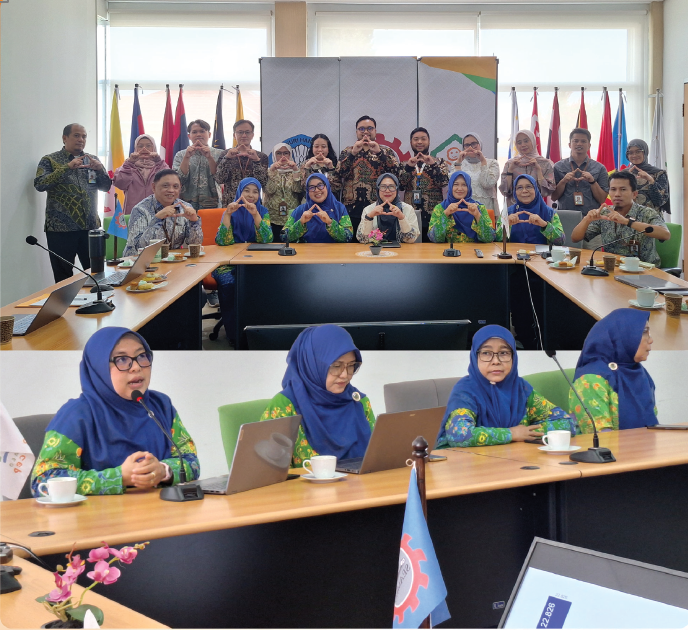
Bandung, 9–11 March 2026 – The Southeast Asian Ministers of Education Organization Regional Centre for Early Childhood Care, Education and Parenting (SEAMEO CECCEP) conducted an Anti-Bias Education Research Preparation Workshop as part of its efforts to strengthen research quality and support the development of more inclusive and equitable early childhood education practices.
The workshop brought together internal and external researchers involved in the anti-bias education study. The activity aimed to reflect on the implementation of previous research while preparing strategies for the next phase of the study, particularly in analyzing bias within early childhood education settings.
The Director of SEAMEO CECCEP, Vina Adriany, emphasized the importance of carefully preparing research plans and allocating sufficient time for data collection in the field. She also highlighted that every Research and Development (R&D) activity should regularly report its progress to monitor the development of the study. In addition to academic publications, the research outputs were expected to include the development of learning modules using the Gender Equality, Disability, and Social Inclusion (GEDSI) framework, as well as dissemination through conferences and other academic forums.
During the reflection session, the researchers discussed their experiences in collecting data from the previous anti-bias study conducted in three research sites. Bias was examined based on GEDSI aspects that appeared in teaching practices, social interactions at school, as well as in school policies and environments. The research team identified several challenges during data collection, including limited observation equipment for classroom documentation, constraints in human resources, and relatively short observation periods. Ideally, classroom observations should be conducted by more than one researcher to ensure better documentation and deeper analysis.
Field dynamics also became an important topic of discussion. Some of the schools selected as research sites were recommended by local education authorities, which meant that the schools tended to represent high-performing institutions. As a result, several responses from school stakeholders appeared less natural, making it difficult to capture the real conditions in everyday practice. Therefore, researchers needed to be more sensitive in identifying biases that often appeared subtly and were not always expressed explicitly.
The participants also highlighted the importance of probing skills during interviews, as many responses from participants tended to be normative. For this reason, the ability to explore deeper insights during interviews was considered an essential competency that needed to be strengthened in the next phase of the research.
In the methodological discussion, the participants explored the possibility of applying the GEDSI framework to analyze different forms of bias found in early childhood education, including gender bias, disability-related bias, and other forms of social exclusion. The framework also opened opportunities for intersectionality analysis, which examines how multiple social identities—such as gender, social class, religion, or ethnicity—intersect in shaping experiences of bias within educational environments.
The research team also considered the use of participatory methods such as photovoice to involve children more actively in the research process. This approach was expected to help capture children’s perspectives and experiences regarding bias that may emerge in classroom activities and social interactions.
In the session on academic writing, Hani Yulindrasari emphasized the importance of clearly formulating the main argument of a research article from the beginning. She explained that the central argument should already be reflected in the abstract and must be grounded in strong empirical findings so that readers could clearly understand the contribution of the study. She also suggested that research findings should be organized systematically to highlight patterns such as gender expectations, the construction of masculinities, and transphobic sentiments that may appear in early childhood education contexts.
She further noted that transphobic sentiments found in educational practices were often rooted in misunderstandings about gender identity. Such sentiments could lead to restrictions on children’s activities, including limitations on certain types of play or classroom participation based on gender stereotypes. These restrictions could ultimately limit children’s creativity and exploration, affecting both boys and girls.
The workshop also highlighted the need to strengthen the research team’s capacity before conducting fieldwork. Processes such as researcher calibration, training in observation and interview techniques, and mentoring in data analysis were considered essential to ensure consistency and depth in the data collected.
As a follow-up, the anti-bias education research was planned to enter the next phase, which included needs assessment and the development of training programs for educators. Through the GEDSI approach, the program was expected to contribute to the creation of more inclusive, equitable, and supportive learning environments for all children.
Through this workshop, SEAMEO CECCEP reaffirmed its commitment to strengthening evidence-based research that supports fair, inclusive, and bias-free early childhood education practices across Southeast Asia.
Bagikan Artikel