
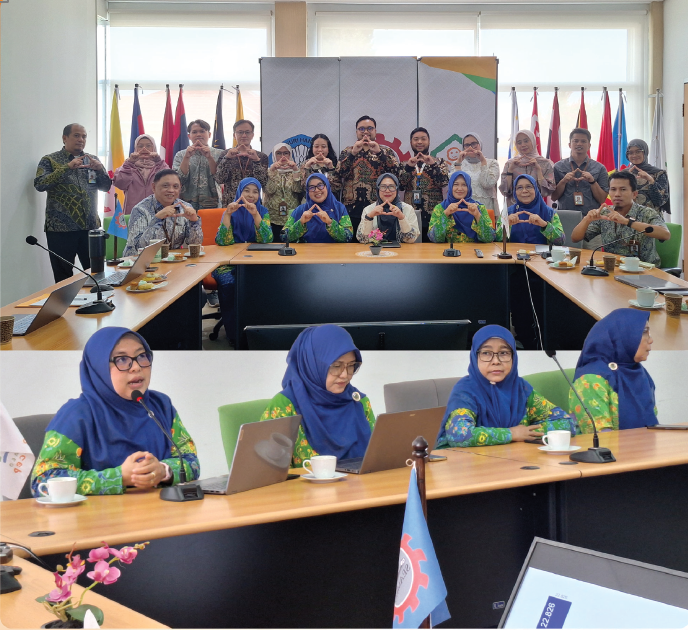
Bandung — On 26 January 2026, the SEAMEO Centre for Early Childhood Care and Education and Parenting (SEAMEO CECCEP) received a courtesy visit from the Majalengka Regency Social Affairs Office to explore potential areas of cooperation. The meeting marked an initial step toward identifying collaboration opportunities in poverty alleviation, accelerated stunting reduction, and the strengthening of early childhood education and parenting in Majalengka Regency.
The meeting was attended by the Secretary of the Majalengka Regency Social Affairs Office, Mr. Ali Nurjaman, along with a collaboration team consisting of H. Agus Asri Satana, M.Si., Fizay Muhammad Fauzan, S.H., and Asep Zaenudin. The session was opened by Widodo, Deputy Director for Program of SEAMEO CECCEP, and was followed by a presentation on the current conditions and social development challenges in Majalengka Regency.
In his presentation, H. Agus Asri Satana, M.Si. explained that, in line with the direction of the Regent of Majalengka, the local government was conducting evaluations of ongoing programs. Key challenges included budget reductions due to efficiency policies, limited facilities and infrastructure, and low public awareness of the importance of education, with the average education level of the population remaining at the junior secondary school level.
He also noted that the relatively high poverty rate remained a fundamental issue affecting various aspects of community life, including children’s health and education. Therefore, the visit to SEAMEO CECCEP was intended to seek joint solutions and open opportunities for collaboration to address these challenges.
During the discussion session, representatives from the Majalengka Regency Social Affairs Office expressed their interest in receiving support from SEAMEO CECCEP, particularly on issues related to stunting and parenting, which had also been major concerns of the Bunda PAUD of Majalengka Regency. Several strategic questions were raised, including the forms of assistance that could be provided (such as training, seminars, FGDs, or other models), the possibility of collaboration involving Bunda PAUD, opportunities to invite SEAMEO CECCEP to Majalengka Regency, and examples of cooperation documents for reference.
In response, Prof. Vina Adriany, Ph.D., of SEAMEO CECCEP, introduced the Centre’s mandate and institutional role and emphasized that poverty, stunting, and parenting were among SEAMEO CECCEP’s core areas of concern. She also explained that SEAMEO CECCEP had various programs that could be implemented collaboratively and could utilize national planning databases, including data from Bappenas, to support the development of needs-based local interventions.
Meanwhile, Widodo elaborated on the role of the Capacity Building Division, including the possibility of conducting regional needs assessments through Focus Group Discussions (FGDs), providing assistance in developing local policies related to stunting and parenting, and facilitating collaboration with other SEAMEO Centres in Indonesia. He also highlighted the potential for cross-centre collaboration should the Majalengka Regency Government formally invite SEAMEO CECCEP to comprehensively assess regional needs.
Further input was delivered by Mr. Suhendri from the Advocacy and Partnership Division, who highlighted the importance of strategic partnerships and policy advocacy in ensuring the sustainability of local programs.
On the same occasion, Mr. Ali Nurjaman emphasized that three key sectors needed immediate strengthening in Majalengka Regency, namely education, health, and community empowerment, as essential pillars for improving the quality of life of low-income communities. In line with directives from the President, Governor, and Regent, stunting was identified as a priority issue that required serious and collaborative action.
The Head of the Advocacy and Partnership Division of SEAMEO CECCEP, Mr. Rizal Nugraha, added that the Centre had experience in supporting stunting reduction initiatives in several regions, including OKU Regency and Pangandaran Regency, using approaches tailored to local contexts. In Pangandaran, interventions were carried out through the empowerment of Bunda PAUD Desa, while in OKU, collaboration was conducted with relevant local government agencies.
He further explained that cooperation schemes could take the form of assistance in implementing Holistic Integrative Early Childhood Education (PAUD HI) governance, starting with a regional readiness analysis, followed by the identification of strategic priorities, and continued with implementation support through various FGDs and technical activities. From a regulatory perspective, such cooperation could be formalized through a Cooperation Agreement (PKS) with the local government.
The meeting concluded with a shared understanding that Majalengka Regency had strong potential to become a locus for research and technical assistance by SEAMEO CECCEP, particularly in relation to stunting, parenting, and poverty alleviation through the strengthening of early childhood education. Both parties agreed to continue communication and to follow up on this initial exploration of cooperation in a more technical and sustainable manner.
Bagikan Artikel